
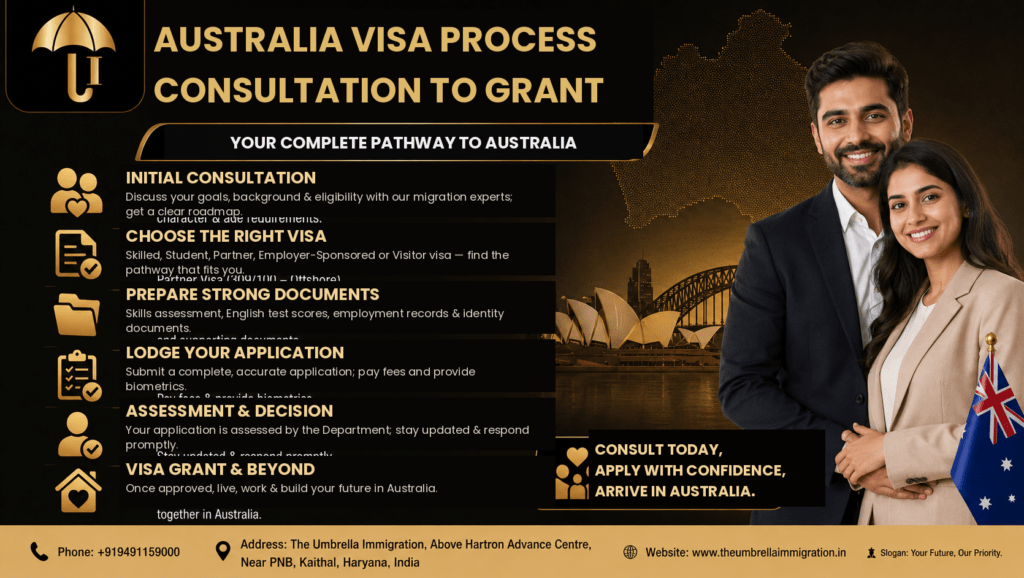
An Essential Guide to the Complete Process from Initial Consultation Through Grant of an Australia Visa
When you consider moving to Australia — for study, work or family — you may be thrilled at the opportunity and ready to encounter new experiences but if you are unfamiliar with the visa process it can seem daunting. This guide is a step by step procedure that serves to assist you from your initial consultation until the day your visa grant arrives.
Step 1: Initial Consultation
This process starts with a consultation with either an RMA, an immigration lawyer, or your own research using the Department of Home Affairs website.During this stage, you’ll typically:
- Dispel to yourself what are you going to do (polską studia, prace, staz na czas nieokreslony, przylaczenie sie rodziny itp)
- They also share their qualifications, experience in the field of work and personal situation
- Assess what visa subclass suits you best
- Timelines and costs involved
This is vital because a good consultation will prepare you to know what to expect and get rid of costly mistakes later on.
Step 2. Select your appropriate visa subclass
Australia provides a variety of visa categories and choosing the perfect one is imperative. Some of the more common ones are:
- Student Visa : Those who want to study in Australia
- Subclass 189 — Points test; No sponsor required
- Skill Nominated Visa — State or territory nominated
- Skeleton Body PDF Export Employer Nomination Scheme — An Australian employer nominates you for a permanent residence visa
- Partner Visa — for those applying as spouses or de facto partners of Australian citizens / residents
- Visitor Visa – for holiday or short-term business visits
Every subclass has its own eligibility, points requirements (if any), and processing time.
3. Skill Assessment (If Required)
Conclusion For skilled migration visas, you will normally need a favourable skills assessment with the assessing authority for your (Occupation name) occupation (such as VETASSESS, ACS for IT professionals or Engineers Australia). This is a verification step to check if the education and the experience you have is at par with Australian expectations.
4: SkillSelect Expression of Interest (EOI)
If you apply for a points-tested skilled visa, the first step where you will apply is through SkillSelect as an Expression of Interest. Here are the scores that will be given to you:
- Age
- English language proficiency
- Work experience
- Educational qualifications
- State or territory nomination (if applicable)
You will also be invited to apply if your score exceeds a threshold.
Step 5: Document Preparation
This is usually the phase that takes the most time. Typical documents required include:
- Valid passport
- Skills assessment results
- English language test results (IELTS, PTE, TOFEL etc)
- Educational certificates and transcripts
- Employment references and payslips
- Police clearance certificates
- Health examination results
- Documents showing proof of funds (certain visa types only)
Having a checklist and preparing documents in advance helps immensely with delays.
Step 6: Submitting the visa application
Your documents are then submitted via the online platform ImmiAccount. This includes:
- Paying the visa application charge.
- Uploading all supporting documents
- Undergoing a health examination through a panel physician
- Submitting biometrics, if required
Step 7: Department Assessment
Once you have lodged your application with the Department of Home Affairs, a case officer will review your application. They may:
- Request additional documents or clarification
- Request for an interview (not usual, but available for certain visa types)
- Conduct background and security checks
Processing times depend heavily on the visa subclass — with some processed in weeks and others spanning many months.
Step 8: Visa Grant
After your application is approved, you will get a visa grant notification by email alongside the conditions of your visa, how long it lasts and if have work study rights. You have to read this notice carefully as it explains national laws and your rights in Australia.
Tips for a Smooth Process
- Be prepared – a few visas have a long waiting period; some can take months and so you are basically preparing yourself to start already up till October 2023.
- Be honest and complete — discrepancies may result in delays or a denial
- Do not throw away any of your paperwork — You will need it for every visa you renew and for your citizenship application
- Track processing times – Home Affairs provides indicative timeframes for each subclass
- Turn to a professional — in complicated cases, a licensed migration agent may provide valuable assistance
Final Thoughts
Getting from consultation to visa grant is a process that takes time, organisation and thoroughness. I know it looks daunting, but really, breaking this down into these steps makes it a whole lot easier. Knowing every phase, No matter you are submitting the application by itself or with a Migration expert throughout the procedure allows you to decide on knowledgeably and steer clear of needless hiccups.