
Related Stories Aust Partner Visa Guide 2026 Everything to DS Sponsoring Your Spouse or De Facto Partner
See with power of attorney lawyers in UKAs most couples set out on one the the most thrilling — and one of the most arduous paperwork-filled procedures they ever undertake, bringing your partner to Australia. The Australian Partner visa is for the partner or spouse of an Australian citizen, permanent resident or eligible New Zealand citizen who wants to migrate to Australia permanently. But between the subclass numbers, the two-stage process, and varying fees at each turn it can be easy to throw up your hands in despair before you even start.
They are detailing the entire process, from who can apply under which of the relevant subclasses to costs and timelines,before covering where people commonly go wrong with applications.
What Is the Australia Partner Visa?
The Partner Visa is not a one stop visa — it is a two-stage map: you initially receive a temporary visa, before applying for permanent residency about two years later. You mentioned filing a single application and also pay one fee for both stages.
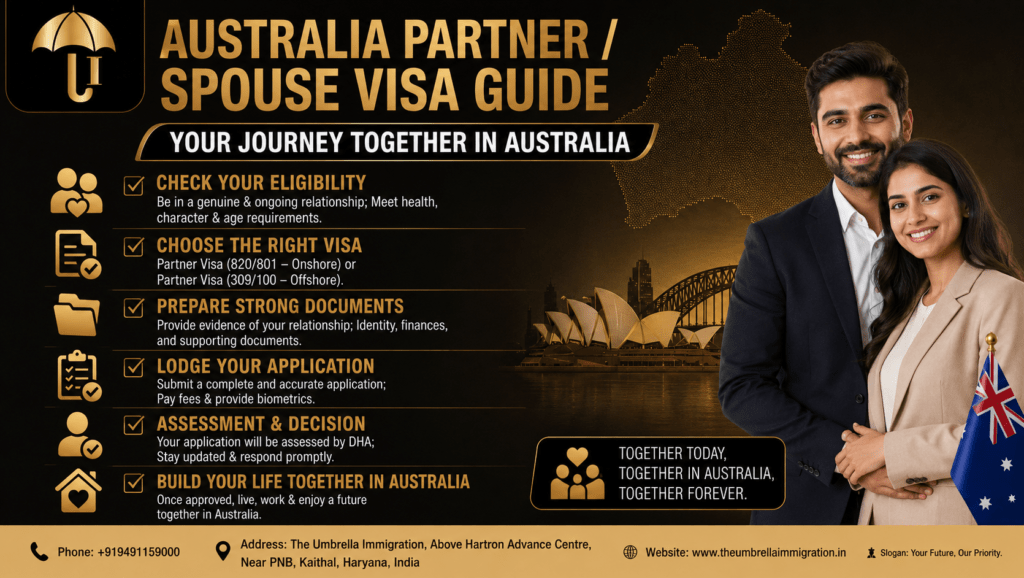
Which subclasses apply depends on your location at lodgement:
- In Australia (Onshore pathway) Subclass 820->Subclass 801
- Offshore route (outside of Australia) – Subclass 309 temporary→Subclass 100 permanent
- Subclass 300 (Prospective Marriage visa); in the process before you marry, not yet living together for a year, can later convert to 820/801 pathway
What to ExpectFor the most part, the requirements and evidence expected along the onshore and offshore routes are largely similar — just where you happen to be at lodgement time and/or decision time.
Who Can Apply?
To be eligible, you typically must demonstrate:
- Your sponsor or you and your family member must : be an Australian citizen, Australian permanent resident, or eligible New Zealand citizen.
- You are married to your sponsor, or in a de facto relationship of at least 12 months duration immediately before lodging (registered relationship is an exception, or compelling circumstances may apply)
- Your relationship is genuine and continuing — not one entered into for immigration purposes
- Both sponsor and applicant meet health and character requirements
There’s no formal English-language points test for this visa, but strong English skills and well-translated documentation make the process smoother and help you build a stronger evidence file.
The Four Pillars of Evidence
Case officers assess “genuine and continuing relationship” claims against four broad categories:
- Financial aspects — joint bank accounts, shared bills, joint loans or property
- Nature of the household — shared address, division of domestic duties, joint tenancy or ownership
- Social context — being known as a couple to friends and family, joint social activities, photos
- Commitment — length of relationship, future plans together, wills or shared long-term decisions
The Department of Home Affairs now prefers applications to be “decision-ready” at lodgement — meaning as much evidence as possible should go in upfront rather than trickling in later. Some case officers only issue one request for further information before deciding based on what’s in front of them, so incomplete applications carry real risk.
Costs to Budget For (2026)
Partner visa fees increased from 1 July 2026. As of now, the base application charge for the primary applicant sits at roughly AUD $11,710 for the combined 820/801 or 309/100 application — though you should always confirm the exact current figure using the Department’s official Visa Pricing Estimator before lodging, since charges are adjusted periodically.
Other costs to plan for:
- Health examinations: approximately $300–$500 per person
- Police clearance certificates: approximately $50–$200 per country you’ve lived in for 12+ months
- NAATI certified translations: $30–80 per page
- Migration Agent Fees (Optional): generally $4,000–$8,000 if a registered agent is used
If you already have a Subclass 300 Prospective Marriage visa (and qualify for the subclass 820 /801), your application fee is much lower because the main cost was already paid at the stage of getting your first partner and/or spouse visa, aka.
Application fees are non-refundable — even if your visa is withdrawn or refused — which is exactly why getting the application right the first time matters more than trying to save time by lodging early with incomplete evidence.
How Long Does It Take?
The DOI does not publish simple averages, but instead processes percentile-based data and time frames vary throughout the year. As a rule of thumb heading into the middle of 2026:
- Subclass 820 (only temporary): mostly between 15-24 months subclass onshore.
- Subclass 801 (Permanent) is usually assessed around 2 years after the application for the 820 is lodged, but then there could be a wait of months to over a year from reaching the eligibility date
Onshore applicants are usually issued a Bridging Visa A while you wait for the 820 decision, meaning you can remain in Australia and continue working.
A significant factor affecting processing speed is how “complete” your application is at the time of lodgement, how strong your relationship evidence and health and character checks are processed.
Common Reasons Applications Stall or Get Refused
Most refusals aren’t because the relationship itself isn’t genuine — they come down to how the relationship was documented and presented. Frequent issues include:
- Thin or one-sided evidence (e.g., mostly photos, with little financial or household documentation)
- Missing or outdated police clearances
- Inconsistent information between the sponsor’s and applicant’s statements
- Evidence gaps around periods of separation or long-distance stretches
- Failing to keep submitting fresh evidence after lodgement, since the relationship must remain genuine and continuing right up to the permanent stage
Step-by-Step: The Application Process
- Confirm eligibility — check your relationship type, duration, and sponsor’s status
- Gather evidence — collect documents across all four pillars, plus identity, health, and character documents
- Lodge the combined application via ImmiAccount — pay the visa application charge
- Receive the Bridging Visa A (onshore applicants) while the 820 is assessed
- Respond promptly to any request for further information
- Receive the 820/309 decision
- Continue submitting fresh relationship evidence during the waiting period
- Apply for the permanent stage (801/100) once the eligibility window is reached, generally about two years after initial lodgement
- Receive your permanent visa decision
Should You Use a Migration Agent?
Given the financial stakes — often $10,000 to $18,000+ once government fees, checks, and translations are included — many couples choose to engage a registered migration agent (identifiable by a MARN number), particularly for:
- De facto relationships where the 12-month cohabitation requirement is complicated
- Long-distance relationships
- Previously refused applications
- Cases involving a prior marriage, dependent children, or character concerns
An agent isn’t required — plenty of straightforward applications are self-lodged successfully — but for complex situations, professional guidance can reduce the risk of a costly refusal.
Final Thoughts
Samantha Smith, a family lawyer and founder of Evans & Partners, said the Australian Partner Visa was one of the most commonly pursued — and costly — visas in Australia’s migration system; with both partners needing to wait two years between application stages. The good news is that if you prepare ahead for the process: Determine which subclass applies to you, create properly supported evidence across all four pillars of the relationships, budget carefully and then keep your documentation fresh over the waiting time — it is a known and predictable process.
This article is purely informative and does not provide information, migration or professional advice. It is not uncommon for visa costs, processing times and requirements to change regularly so it is always safer to check the Department of Home Affairs website for up to date information or consult a registered migration agent on your individual circumstance.