
189 vs 190 vs 491: Why NOT all Australian skilled visa numbers suit your favourite!
If you have already commenced your research into the skilled migration to Australia you would no doubt have seen these three numbers 189, 190 &491 appearing all over the place. All pathways lead to permanent residency, all use the same points test, and at a glance they can seem deceptively similar. However, taking the wrong one RIGHT MEANS you could wait months — sometimes even years!
The Umbrella Immigration have weekly conversations with applicants who complete the points calculator, cross check their occupation against the skilled lists but find themselves stuck at one very simple question — which visa is right for me?
This blog peels back the layers of what Subclass 189 vs 190 is (and why this matters), and lastly, how to think about each one for your points, when/where you want it done.
The Quick Overview
All three of these visas are within Australia’s General Skilled Migration program and share the same points test, which has a pass mark that starts at no lower than 65. However, that is the end of their similarity.
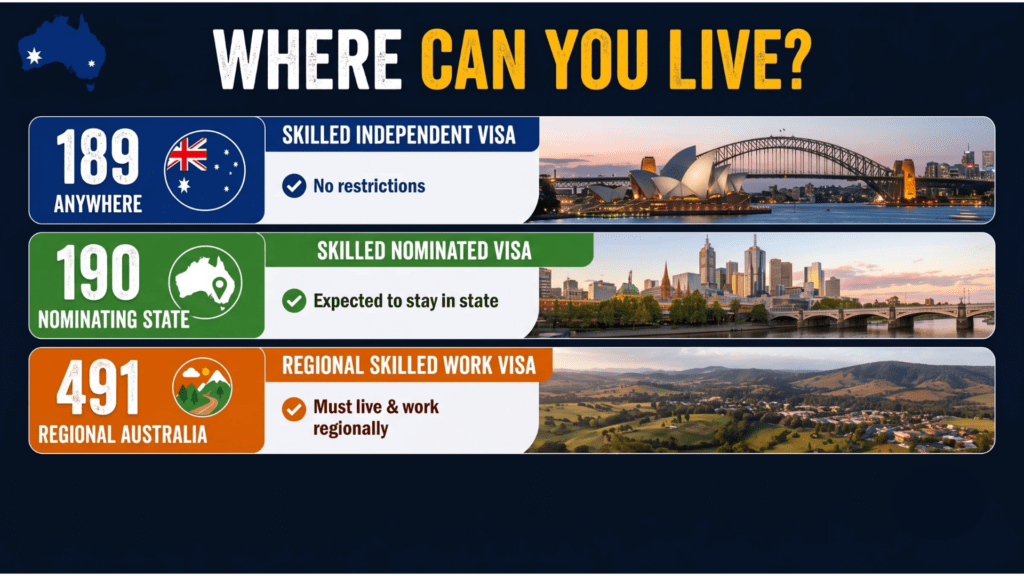
- Subclass 189 Skilled Independent: A permanent visa without the need for sponsorship. From the day that it is granted whilst you can live and work anywhere in Australia
- Subclass 190 (Skilled Nominated): A permanent visa that is obtained with a nomination from the Australian state or territory government, resulting in additional points.
- Subclass 491 (Skilled Work Regional): Provisional visa requiring nomination by a state/territory or sponsorship from an eligible family member, attached to residing and working in designated regional area with permanent residency pathway available down the track.
So let’s break each of them down one by one.
Subclass 189: The Independent Pathway
Subclass 189 is known as the “dream ticket” of the Australian skilled migration system, and there’s reason for the hype. There is no employer sponsor, state sponsor, or family sponsor. Instead, your invitation is simply a matter of your points score and your nominated occupation being on the Medium and Long-term Strategic Skills list (MLTSSL).
Benefits of Subclass 189
With this visa, you get the:
- Right to live and work freely anywhere in Australia
- Full permanent residency as soon as your visa is granted
- No obligations to any state, region or sponsor
The Catch: This visa is the most desirable and the most flexible, therefore, the competition is most intense. The official minimum is 65 points, however, the most successful applicants in 2026 will be in the range of 85 to 100+ points, and this is particularly true for high-demand occupations such as accounting, software engineering, and other occupations in the ICT space. For some occupations, scoring 85 points will not guarantee an invitation in a reasonable timeframe, and the wait could easily be more than a year.
Best suited to: If your points score is strong, your occupation is on Australia’s National Skilled list, and you do not really mind where you settle in Australia, the 189 visa is the most worthwhile pathway to consider.
Subclass 190: The State Nomination Pathway
Subclass 190 offers a different route to permanent residency. This pathway requires you to be nominated by one of the Australian states or territories. The main difference is you get an additional 5 points.
What you get
- Again, you get permanent residency the same as the 189.
- The extra 5 points could mean the difference in receiving an invitation or not.
- The state nominated pathways can provide a broader list of eligible occupations than the national list.
The catch: There is no formal, legal obligation to stay in the state, however as a general expectation, it is looked at favorably if you stay for 2 years. If you do decide to leave, it may be seen negatively if you require support from the state in the future, for example if a family member applies for nomination from the same state.
Each of the states and territories get to decide their own occupation lists and requirements. In addition, sometimes states and territories may require you to have a job or have worked in that state prior to applying. These are subject to change so you may have different requirements from someone who applied previously.
Who it suits: If your points score is marginally below the 189 subclass requirements, or if you are open to living in a specific state for a few years, this is a more likely route to a quicker invitation.
Subclass 491: The Regional Pathway
Subclass 491 is all about enticing migrants to move to regional parts of Australia with 491 nominations or eligible family sponsorship netting 15 points to the applicants overall (and highest) score among the three pathways.
Benefits include:
- Largest point bonus among the three visas helping to boost borderline scores to competitive levels.
- Access to state and regional occupation lists, which are usually the most populated of the three visas.
- Less competition among other applicants
The Catch: While application pathways 189 and 190 are popular among applicants, the 491 pathway is not.Where the 491 pathway differs from the 189 and 190 pathways is that the 491 is a provisional visa for 5 years. For those 5 years, the applicant must live and work in a designated regional area, as well as meet a number of income requirements. After 3 years of meeting these requirements, applicants are eligible and can apply for permanent residency via the Subclass 191 visa.
A common misperception of the term “regional” is that it refers an area so far away or out in rural lands. With regional here meaning not the distance to the city center but rather postcode based. List of Regional CitiesIn this program, some very big cities are essentially classified as regional cities like: Adelaide, Perth, Gold Coast, Newcastle, Geelong, Wollongong & Hobart and Canberra too.
Who it is for: If your points score is below the competitive cut-off for the 189 or 190, or you can tolerate at least three years commitment to a regional location in exchange for a faster invite and road to PR, then 491 is usually the most realistic and accessible option.
A Side by Side Comparison of the Three Visas
A Side by Side Comparison of the Three Visas
|
Feature |
189 |
190 |
491 |
|
Visa type |
Permanent |
Permanent |
Provisional (5 years) |
|
Sponsorship required |
None |
State/territory nomination |
State/territory nomination or family sponsorship |
|
Points bonus |
None |
+5 |
+15 |
|
Location condition |
None |
Expected ~2 years in nominating state |
Mandatory 3 years in regional area |
|
Occupation list |
National (MLTSSL) |
State-specific (often broader) |
State-specific (often the broadest) |
|
Pathway to PR |
Immediate |
Immediate |
Via Subclass 191 after 3 years |
|
Typical competitive points |
85+ |
75+ (including bonus) |
65-75 (including bonus) |
So what visa is indeed suitable to be with you?
No one visa is superior to any of the three — each best depends on your profile. A simple way to think about it is the follow:
Get the189 if: You have a solid competitive points score of your own, youre on the national skilled list and want a ticket to go wherever in Australia you please with no ties.
Pick the 190 if: Your points score is pretty good, but you’re not quite up to that level where a 189 invite will happen yet; and You’re willing to nominate yourself in a certain state for a year or two for getting PR straight away and having an easier chance of being invited.
You should go for the 491 if: You are less than what’s competitive for the 189 or 190 points-wise, or you just want to maximise your chances of getting an invite as soon as possible and you’re happy to live in regional Australia (though that still could be a decent sized city like Adelaide or even Gold Coast) for a minimum of three years before being able to work towards PR.
Many applicants also use a combined strategy: maintaining an active Expression of Interest (EOI) for the 189 while holding a 491 visa. If a 189 invitation eventually comes through and all requirements are still met, you can apply for it — giving you the security of an earlier regional pathway while keeping the door open to full independence later.
Common Mistakes We See Applicants Make
Over the years, we’ve seen several recurring mistakes that cost applicants time, money, and sometimes their invitation altogether:
-
- Treating 65 points as a competitive score. It’s the minimum required to submit an EOI — not a guarantee of an invitation. Most successful applicants score well above this, particularly for the 189.
- Ignoring state-specific nomination requirements. Every state sets its own occupation list, English requirements, and sometimes work experience expectations. Applying to the wrong state with the wrong assumptions can lead to unnecessary rejections.
- Underestimating the full timeline. Between skills assessment, English testing, EOI submission, waiting for an invitation, and then the visa application itself — including supporting forms, health examinations, and police clearances — the entire process can take well over a year from start to finish.
- In case of waiting too much to submit an EOI. A tie-break rule is in place in Australia’s invitation system: where two applicants have drawn points scores, the applicant who reached that score first typically takes precedence. Attempting to refine every aspect while putting off your EOI can actually weaken your competitive stance.
- Assuming a 491 traps you in a remote location. As covered earlier, “regional” includes many well-developed cities. Understanding exactly which areas qualify in your state of interest can open up options you didn’t know existed.
Get Expert Guidance Before You Choose
Selecting between the 189, 190, and 491 isn’t just about your points score — it’s about your occupation, your flexibility on location, your long-term settlement goals, and how quickly you want to move to Australia. Getting this decision right from the outset can save you significant time and prevent costly missteps along the way.
At The Umbrella Immigration, our team helps applicants assess their points, identify the right occupation and state pathway, and build a strategy tailored to their individual circumstances — whether that means an independent 189 application, a state-nominated 190, or a regional 491 pathway with a clear route to permanent residency.
Contact The Umbrella Immigration today for a professional consultation, and let us help you choose the pathway that truly fits your goals — not just the one that sounds the most familiar.