
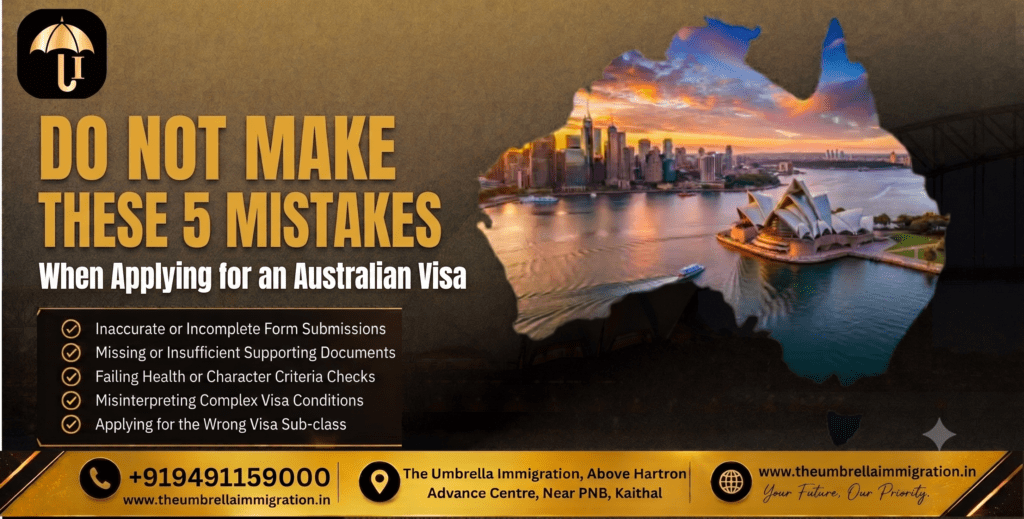
Consider the following 5 visa application blunders to avoid when applying for an Australian visa.
The process of completing an Australian visa application can be a maze of paperwork, checklists and requirements. Whether you’re applying for a tourist visa, student visa, skilled migration visa, or partner visa, any error in your application could lead to a visa delay, additional paperwork or visa denial.
The downside is that the majority of applications that are rejected or delayed are not actually due to the applicant’s inability to meet the requirements — they are simply due to some avoidable errors: the applicant may have forgotten to provide an application with the required document, the applicant’s personal statement may be too general, or the applicant may have applied for the wrong visa subclass. Here are the top 5 most common errors that applicants make, and what you can do to avoid them.
Failure to submit incomplete or inconsistent documentation.Failure to provide Incomplete or inconsistent documentation.
A complete or incomplete paper is one of the biggest reasons for application delays or rejection. Case officers receive thousands of applications and anything that doesn’t add up, or isn’t present at all, raises additional eyebrows and more questions, or causes applications to be rejected. Common issues include:
- If necessary, to be able to obtain certified copies of important papers (e.g. passports, qualification transcripts).
- Any name, date or information that doesn’t match between documents.
- Obsolete Police clearance and/or Medical records
- Failure to provide evidence to support the statements on the form, such as relationship evidence for a partner visa
How to prevent it: Make a list of the documents required for your visa subclass and double check against all documents before submitting your application. Attach certified copies of documents in languages other than English and verify the dates of polices and medicals.
2. Underestimating Financial Requirements
For many visa types, the question of whether there are adequate funds is relevant — for a student visa, the cost of tuition and living expenses as well as for a temporary visa, a genuine access to money. Many applicants do not realize the level to which case officers will look into a financial statement or think that any amount in a bank account is acceptable. Common mistakes include:
- Failing to provide bank statements with a consistent financial statement.
- Not taking into account the exact amount needed, which fluctuates and needs to be paid for tuition and living expenses and for dependents’ travel expenses;
- Don’t leave any unexplainable large deposits
- Taking informal loan or sponsoring letter without supporting documents
How to prevent it: Be sure to refer to the latest minimum financial requirements listed on the Department of Home Affairs website as the minimum requirements are subject to changes. Make sure your paperwork is up to date, consistent and well explained – preferably with a consistent balance over a few months, rather than a lump-sum deposit. If you have someone sponsoring you, include a letter of support in your evidence and proof of relationship.
3. Failure to satisfy the Genuine Temporary Entrant (GTE) or Genuine Visitor Requirement
Applicants for student and visitor visas in particular will be required to establish a genuine intention to abide by visa conditions, and to leave Australia (or transition lawfully) in accordance with the conditions. It’s the part of the application that is most subjective, and also where many good applications miss the mark. Common mistakes include:
- Filling in a generic, copy/paste statement which is not reflective of the situation.
- Not providing information on how the course of study is related to career objectives at home
- Failing to give any evidence of being connected to their country of origin.
- Recognizing the importance of tackling visa rejections from the past
How to prevent it: Prepare an individual statement, which explains your relationship with your home country, your real purpose for the visit or study, and what you intend to do after your visa expires. Be specific – say what career pathway you are on, your financial situation, and why it is relevant to you to take this course or trip. Generalised and template answers are a big turn off as case officers can easily see that the answer might be suitable for anyone.
4. Absence of and/or incorrect Health and Character Requirements
All Australian visa holders are required to have a health assessment and character assessment and this is frequently done at the end of the visa application process, leading to a heavy backlog. Mistakes here include:
- Failure to attend the required health exams with an approved panel physician, or being too late
- Disclosing criminal background even minor offenses is not disclosed.
- If an applicant has a health condition, they are automatically ineligible for admission, without consulting a doctor or professional medical adviser.
- Not having all family members checked for health on the application
How to prevent it: Plan your health examination early – preferably when you apply – to avoid becoming a blockage. Disclose everything about yourself, even if it’s a minor incident, and if you’re not sure, get professional advice about whether or not it should be disclosed. It is much riskier to keep information confidential than to disclose it because it can result in cancellation of your visas or even a refusal to issue visas in the future.
6. Misrepresenting Information on the Applicant’s Visa Application
There are dozens of visa subclasses and sometimes applicants select visa subclasses that are not relevant to their situation or purposes. It can occur when a person uses out-of date information or friend’s recommendations based on a different process. This can result in wasted time, non-refundable fees and even a formal rejection that could impact on future applications.
How to avoid it: Research, research, research and find out what subclass visa suits you before applying, taking into account your intentions, visa length, qualifications, your long-term aims (permanent residency) and much more. In more complex cases (skilled migration, business visas or prior refusals), there is also a visa finder tool on the DOHA website, but it may be sensible to seek advice from a registered migration agent.
Final Thought
The visa application process to Australia can be simplified. If you steer clear of these five significant pitfalls, you’ll increase your chances of a successful application process significantly: incomplete documentation, financial inadequacies, poor genuine intent statements, missing health and character requirements, and selecting the wrong subclass.
What all five mistakes have in common is that they are all about preparation. Visa applications are based on a clear understanding by applicants of what they will be required to provide for their particular subclass, along with comprehensive and consistent information and a genuine self-portrayal of the applicants’ situation.
Remember, if there is any aspect of your application that you are not sure of, it is worth seeking advice from a registered migration agent or from the latest advice on the Department of Home Affairs website—requirements and financial thresholds can change rapidly. Some extra care at the application stage can get you months off track — or the extra expense of a refusal — down the road.