
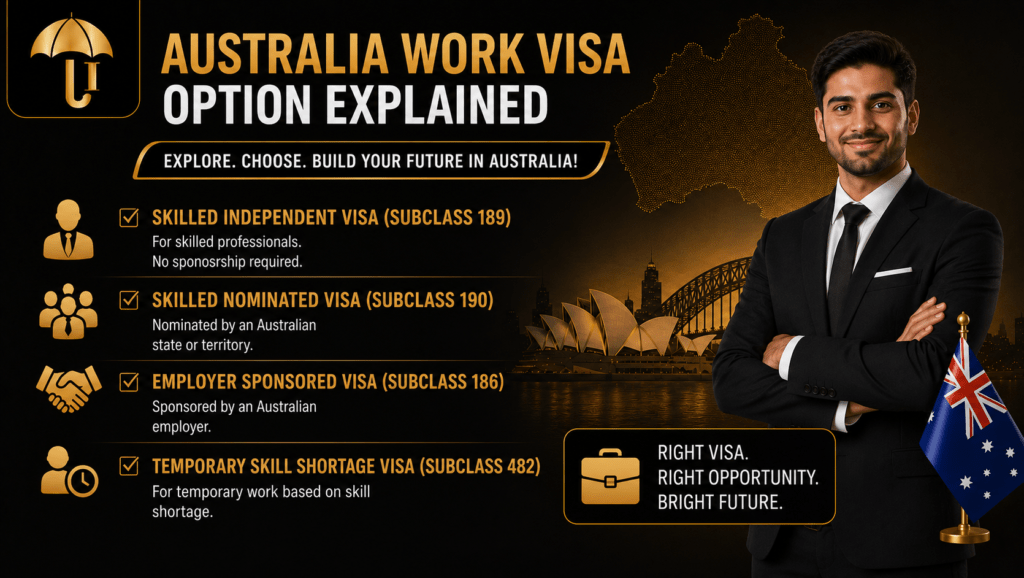
All of the Australia Work Visa options are found in this guide that has been written fresh for 2026
Australia is still one of the most favourable destinations for skilled workers, graduates and young people wishing to work abroad. There are over a dozen different visa subclasses available, so it can be tempting to feel like finding out which pathway fits your case best is an insurmountable challenge. This guide splits the primary categories so that you can quickly pinpoint where you are and what should be your next action.
The Three Broad Pathways
It is important that before exploring individual visa subclasses, you understand that most Australian work visas fall into three different categories:
- Points-tested independent visas — these are for those who meet the criteria as a skilled worker based solely on their own merit through an Expression of Interest (EOI) — meaning that they do not require an employer or state to sponsor them.
- Employer-driven — an Australian business sponsors you for a role.
- Regional and graduate pathways — intended to direct talent into the regions or keep international students in Australia after their studies are finished.
Now, let’s explore each in greater detail.
1. Skilled Independent Visa
This is a PR with no employer sponsored, or state nomination. 2-1 >You’ll be tested on points and for many occupations, scores are competitive from about 85 to 95 + by 2026. It needs to be listed on the Medium and Long-term Strategic Skills List (MLTSSL), before your aggregate score based on age, qualifications, work experience and English ability are taken into account.
Best for: Highly skilled workers with high points scores, and flexibility to move without a job offer.
2. State Nominated Visa
The same as the 189 but state or territory government nominated; a move that generally provides bonus points to your application and might make the difference between qualifying, and not. In return, you will often have to agree to reside in the nominating state for a time.
3. Skill Shortage Visa
Previously called the Temporary Skill Shortage visa, this is now the primary employer-sponsored visa for temporary entry into Australia. It has three streams (Core Skills [from AUD $76,515], Specialist Skills [from AUD $141,210 covering most ANZSCO occupations] and Labour Agreement) with up to four years for each and requires an Australian employer to nominate you.
The upside: after two years working for the same employer, this visa will allow you to apply for permanent residence through the Subclass 186 visa as well.
Ideal for: Qualified workers with an employer who can sponsor them.
4. Employer Nomination Scheme
Direct Permanent Residency Visa (it is an Employer sponsored visa and has 3 streams of Temporary Residence Transition stream after two year transition on from a 482, with Direct Entry requiring job offer and labour market testing decompermanent resident and skills assessment. Which means PR from day one, for a duration of 5 years with same employment obligations and provides you an easier pathway to PR via the Subclass 191 visa after working regional for three years.
5. Skilled Regional Visa
A points-tested visa for skilled workers who are ready to work and live outside major cities of Australia. Holders may work full time, but they are required to live and work in the specified regional area — working in a metropolis without approval can violate your visa regulations. After working and living in the designated region for an established amount of time, this visa transitions into a path to permanent residency.
6. Graduate Visa
Temporary Graduate route — For international students who have recently graduated with an eligible qualification from Id. It is probably the most open-ended of all temporary visas — graduates from any discipline can work for anyone, in any sector and hours, no restrictions. Duration is based on the degree that you have studied and where the study was undertaken: metropolitan bachelor#39;s or coursework qualifications qualify for 2 years; a Masters by research, other Doctorates or eligible degrees completed in a regional area may obtain up to 4 years. When it comes time to apply for permanent residency, there are also a few types of points-based visas.
Costs have also ramped-up: the base application fee for a principal Subclass 485 applicant went from AUD $4600 in March 2026 (AUD $2300 if there were entry to Australia applicants that are over 18 years of age on the visa; AUD $1160 entry to Australia applicants who are under 18 years of age).
Visa type: Graduate Work Visa (subclass 485) Great for: International students who are fresh out of their course and need to secure local experience in order to create a more permanent opportunity within this country.
7.Working Holiday Visas
For younger travelers seeking a combined work and travel result – not long-term migration results. There are two types of Working Holiday Visa — Subclass 417 (Working Holiday) and Subclass 462 (Work and Holiday) — which one applies to you will depend on the passport you hold. Both are mostly also open to those between 18 to 30 (some countries allow for up to age 35), with a validity of generally 12 months that can be extended through prescribed regional work.
Ideal for: Young people looking to travel rather than settle.
So Which Visa Is Suitable for You?
It takes a few questions to narrow things down:
- Have a job offer from an employer in Australia? Check Subclass 482, and later on last but not the least 186 grant.
- Are you looking to be on a Permanent Residency without sponsor? You may like options for Skilled Independent, points-tested (Subclass 189 or 190 with state nomination respectively).
- If you are based regionally, do you mind a change of pace? 491 and 494 pathways are usually less competitive with additional benefits.
- Just Graduated in Australia? As you build your experience, the 485 provides you with full rights to work.
- Are you looking for something laidback to travel around for a year, or two? That’s what the 417 or the 462 working holiday visas are made for.
Final Thoughts
There is no one-size-fits-all Australia work visa, but it really does depend on your profession, qualifications, how good your English is (whether you want a longer-term permanent residency or only doing long term work experience). The visa rules change all the time, so having a look at the Department of Home Affairs webpage or you may spend countless dollars with a registered migration agent before lodgement.
Disclaimer: The information contained in this article does not constitute as migration advice. Attention: Issuance rules, rates, and conditions of the visa may change without notice at any time!